
The Retailer’s Triangle: Why Retailers Push Some Brands & Ignore Others.
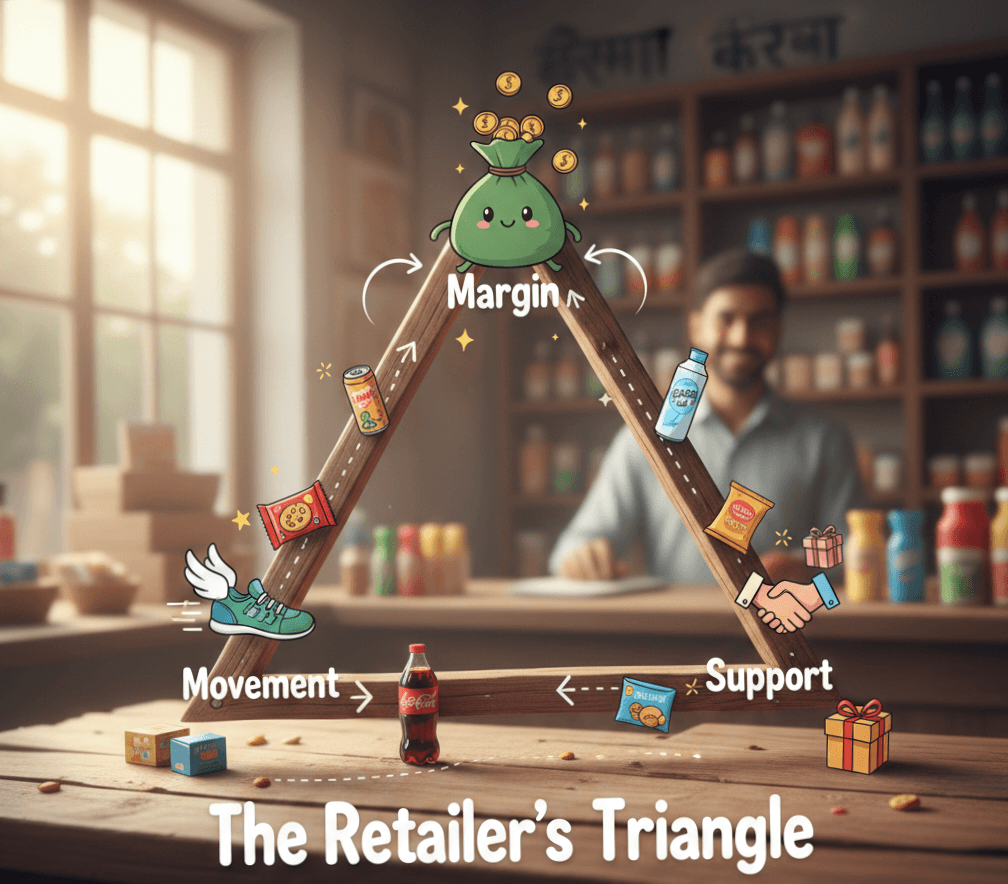
In every kirana, supermarket, or rural retail counter, one pattern is constant. Retailers don’t push all brands equally. Some brands get attention, visibility, and repeated recommendations, while others quietly sit on the shelf.
This behaviour is not random. It follows a simple logic we call The Retailer’s Triangle, built on three powerful forces:
1️⃣ Margin - What do I earn?
Retailers immediately check the profit per pack. If the margin is high, they naturally push the brand more. If the margin is average or low, the brand must compensate in other ways.
Why margin matters?
1. Higher earnings per unit
2. Better cash rotation
3. More motivation to hand-sell the product
But the truth is margin alone cannot guarantee push.
Advertisement
2️⃣ Movement - How fast does it sell?
Movement is the heart of the Retailer’s Triangle. Even if the margin is low, a brand with high rotation is a retailer’s favourite because:
1. It frees up shelf space quickly
2. It brings daily or weekly cash flow
3. It reduces expiry/slow-moving risks
4. Retailers trust products that bring consistent walk-in demand.
3️⃣ Support - Who cares about me?
Support influences how the retailer feels about the brand.
This includes:
1. Regular visits by the sales team
2. Point-of-sale materials
3. Schemes or combo offers
4. Visibility support (Racks, danglers, signage)
5. Relationship and trust
Retailers push brands that commit to their growth, not just their shelves.
Every retailer calculates the Retailer’s Triangle silently in their mind. Brands that understand these three forces and balance them well always win the push.
#FMCGInsights #RetailStrategy #SalesExecution #ChannelMarketing #FMCGInfluencers #RetailGrowth #DistributionExcellence #BrandBuilding #SalesLeadership #TradeMarketing #MarketExecution #ConsumerGoodsIndustry #RetailOperations #MarketingStrategy #FMCGCommunity